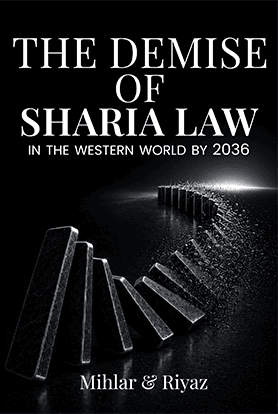
About the Book

The Demise of Sharia Law in the Western World by 2036

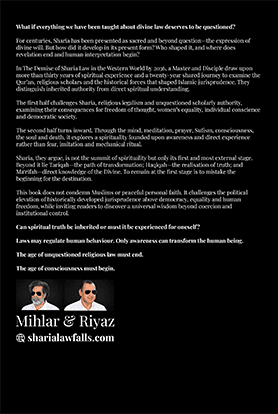
The Demise of Sharia Law in the Western World by 2036 is a bold examination of religious law, inherited authority and humanity’s search for spiritual truth

For centuries, Sharia has been presented to millions of people as an unquestionable expression of divine will. This book asks a fundamental question: where does divine revelation end and human interpretation begin?

Questioning
Authority

Inner
Transformation

Spiritual Truth
& Awareness

Two Parts. One Transformative Journey.

The book takes readers through two distinct but inseparable journeys—from questioning outward authority to discovering the truth within

01

Part One: Questioning Religious Authority

The first part examines the historical development of Sharia and the authority claimed by religious scholars and institutions. It explores the relationship between the Qur’an, Hadith, jurisprudence, legal schools and political power.

It also considers the consequences that arise when religious law is placed beyond criticism, particularly for freedom of thought, women’s equality, individual conscience, religious minorities, former believers and democratic society.

02

Part Two: The Journey Within

After examining outward religious authority, the book turns towards the inner dimensions of human existence.

Through chapters on chakras, the conditioned mind, meditation, Sufism, consciousness and death, the authors explore a spiritual path founded upon awareness, self-knowledge and direct experience.

01

Part One: Questioning Religious Authority

The first part examines the historical development of Sharia and the authority claimed by religious scholars and institutions. It explores the relationship between the Qur’an, Hadith, jurisprudence, legal schools and political power.

It also considers the consequences that arise when religious law is placed beyond criticism, particularly for freedom of thought, women’s equality, individual conscience, religious minorities, former believers and democratic society.

This part asks readers to distinguish between Islam as a personal faith, divine revelation and the human legal interpretations created across later generations.

02

Part Two: The Journey Within

After examining outward religious authority, the book turns towards the inner dimensions of human existence.

Through chapters on chakras, the conditioned mind, meditation, Sufism, consciousness and death, the authors explore a spiritual path founded upon awareness, self-knowledge and direct experience.

The book argues that outward discipline may regulate behaviour, but rules and rituals alone cannot awaken consciousness. Genuine spirituality begins when knowledge is transformed into experience.

Beyond the First Rung

From the perspective presented in this book, Sharia is not the summit of the spiritual journey. At most, it represents its first and most external rung.
Beyond outward law lie Tariqah, the path of inner transformation; Haqiqah, the realisation of truth; and Ma’rifah, direct spiritual knowledge.
To remain entirely occupied with external rules while claiming possession of the whole truth is to mistake the beginning of the journey for its destination.

The book’s Sufi framework presents four stages of the spiritual journey

Sharia

The first and most external rung, concerned with outward rules, conduct and social order.

Tariqah

The path of inner transformation.

Haqiqah

The realisation of truth.

Ma'rifah

Direct spiritual experience.

Read an Extract

Explore a selection of carefully chosen passages from the book.

Book cover — replace with your actual book cover image
01

The Question That Breaks the Whole System

A fundamental question that challenges the very foundation of the traditional legal system—if divine law was complete, why was it not fully revealed by the Prophet?


02

The Third Territory

Exploring the space neither science nor organised religion fully owns—spirituality as the direct, first-person investigation of consciousness, existence, and the self.

03

Science Without Consciousness — The Cost We Are Already Paying

Why technological power without inner wisdom creates new problems. Science must grow inward to complete the picture.

04

“Die before you die.”

A timeless teaching on ego, awakening, and unity—birth, life, death, and the return to the source in one simple but profound image.
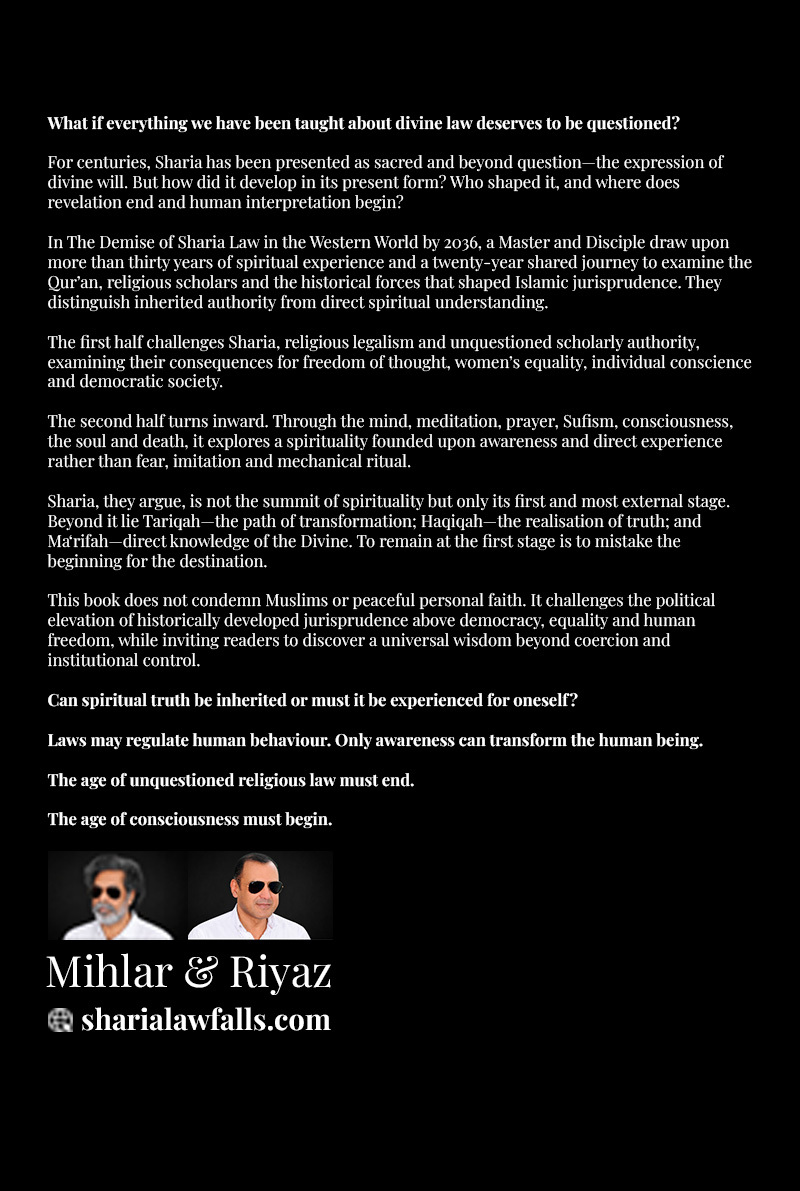
A Journey Spanning Nearly Two Decades

This book emerged from a Master–Disciple journey that began in 2007, supported by more than thirty years of Mihlar’s spiritual inquiry and lived experience. It is the culmination of sustained research, travel, observation, reflection and direct spiritual exploration.

Why “by 2036”?

The year 2036 represents both a prediction and a declaration of purpose. It does not predict the disappearance of Islam, personal faith or voluntary religious practice. It anticipates the decline of Sharia’s political, legal and intellectual authority in Western societies.

As its historical development and human consequences become more widely examined, the authors believe that its claim to unquestionable divine authority will continue to weaken. The date therefore represents a call for open examination, public understanding and spiritual freedom.

the book

A bold examination of religious law, inherited authority and humanity’s search for spiritual truth.

For centuries, Sharia has been presented to millions as an unquestionable expression of divine will.

This book asks a fundamental question: Where does divine revelation end and human interpretation begin? It investigates how the system now called Sharia developed through later generations of jurists,
rulers and political movements-often blending
religion with culture, power and control.

An Invitation to Question

This book does not ask readers to exchange one unquestionable belief for another. It invites them to investigate. Readers may agree with its conclusions, disagree with them or challenge them. The authors ask only that its questions be approached with openness, sincerity and intellectual courage.

The demise of Sharia law in the Western world does not mean the demise of Islam, personal faith or spirituality. It means rejecting religious coercion and creating an opportunity to rediscover spirituality through freedom, awareness, inner transformation and direct experience of the Divine.

Can spiritual truth be inherited through rules and beliefs—or must it be experienced for oneself?

Scroll to Top